
May 2019
SMA presenting at the AusIMM WA 2019 Lithium Conference.
SMA is pleased to announce that Steve Wilson will be presenting a short presentation on the Buchanans LCT Pegmatite Field at the 2019 Western Australian Lithium Conference.
The abstract for the conference will high light the potential of the Buchanan LCT Field to hold a world class LCT resource and focus on the technical studies that have been done to date, the Abstract is as follows:
Wilson, S.R1, Crighton, B2 and Willett, G3
- Senior Geologist, Geological Solutions Pty Ltd, Cooroy QLD 4563. Email: SWilsongeo@outlook.com
- Director of Exploration, Strategic Metals Australia Pty Ltd, Cooroy QLD 4563. Email: BCrighton@strategicmetalsaustralia.com
- CEO, Strategic Metals Australia Pty Ltd, Pinbarren QLD 4568. Email: GWillett@strategicmetalsaustralia.com
ABSTRACT
The Buchanan’s Lithium Cesium Tantalum (LCT) Pegmatite Field is situated near Georgetown in Northern Queensland, Australia. A series of lepidolite bearing pegmatites conforming to the lepidolite sub-type of the complex rare element type (Černý and Ercit, 2005) have been identified along with pegmatites of the Albite sub-type in the nearby tin-tantalum field at Grants Gully. The occurrence of anomalous lithium and tantalum values in stream sediments and rock chip samples over an area exceeding 14 000 ha indicates the Buchanan’s LCT Pegmatite Field has the potential to host world class resources of these rare elements (Figure 1).
The Buchanan’s LCT pegmatites intrude Paleoproterozoic metasediments and dolerites of the Robertson River Subgroup in the Etheridge Province of the Georgetown Inlier (Budd, 2001). Multiple episodes of deformation are recorded in foliations and folds with peak metamorphism thought to coincide with intrusion of voluminous peraluminous, S-type granites of the Forsayth Supersuite immediately east of the pegmatite field at around 1554-1550 Ma (Black and Withnall, 1993). Analysis of element concentrations in the granites proximal to the field suggest a trend of increasing fractionation along an elongate corridor projecting from the main Forsayth batholith, north-westerly toward the LCT pegmatite field. This structural corridor is bounded by lineaments clearly discerned on magnetic and radiometric images of the area and are thought to reflect deep-seated discontinuities that may have played a significant role as conduits for mineralised fluids.
The granite fractionation culminates in leucogranite outcrops that show significant enrichment in Li, Ta, Rb and Cs with the rare element pegmatites apparently spatially related to the most fractionated granites. Geochronology (40Ar/39Ar) was conducted on LCT pegmatite and Buchanan’s Creek Leucogranite samples (Hutton, February 2018, personal communication) and indicates closure of the system some 100 Ma after emplacement of the Forsayth Batholith (1442+/-6.3 Ma), a curiosity that has precedent in many LCT pegmatite fields around the world (e.g. Zagorvsky et al, 2014). Fractionation is also apparent between pegmatites, with those proximal to the granites relatively poor in lithium and the most enriched pegmatites generally occurring 300 to 500 m from the granite outcrop.
Internal zoning of the highly fractionated pegmatites is pronounced, with at least 6 distinct zones recognised including; outer quartz-albite and quartz-feldspar zones and inner lepidolite-albite-quartz, lepidolite-quartz and quartz zones. Drilling of several pegmatites has given an average JORC grade of 1.32 % Li2O, 250 ppm Ta2O5, 620 ppm SnO2, 0.13 % Cs2O and 0.5 % Rb2O. Individual lepidolite hand samples may reach grades as high as 5.0 % Li2O, 1.5 % Cs2O and 1.7 % Rb2O.
Recent drilling has identified broad alteration halos in mica schists with 1 metre core intervals assaying as high as 1.1 % Li2O. Sampling of altered bed rock in the vicinity of the pegmatites also indicates the potential for lithium mica replacement deposits in the area surrounding the leucogranites. The large volumes of source granites, structurally favourable location and numerous geochemical anomalies in the area support our contention that the Buchanan’s LCT Pegmatite Field has the potential to host a world class lithium deposit.
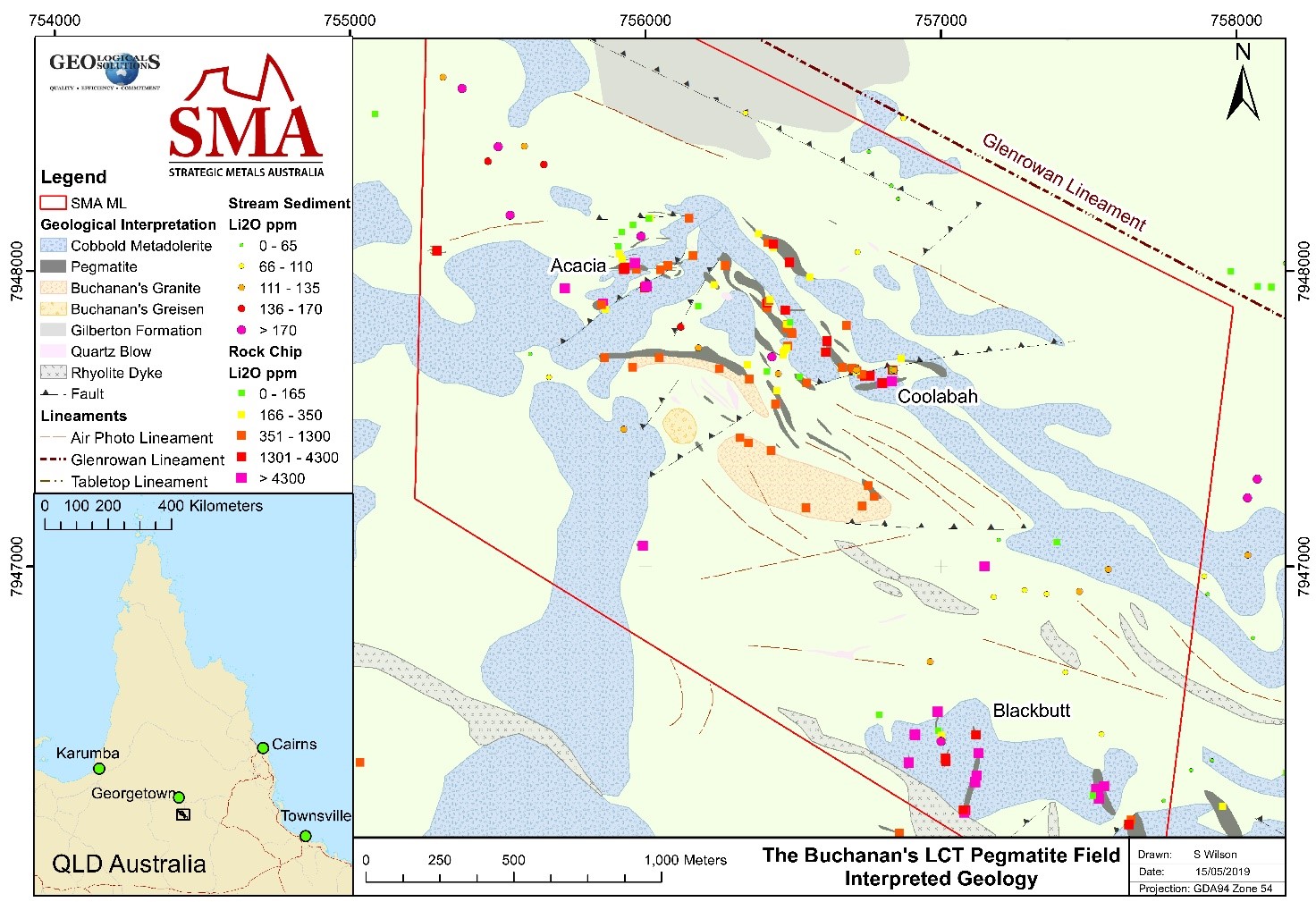
Figure 1: The Buchanan’s LCT Pegmatite Field
References
Black, L P, and Withnall, I, 1993. The ages of Proterozoic granites in the Georgetown Inlier of north-eastern Australia, and their relevance to the dating of tectonothermal events. 14. 331-341.
Budd, A, 2001. Georgetown Inlier Synthesis. Geoscience Australia. 92p.
Černý, P, and Ercit, T S, 2005. The classification of granitic pegmatites revisited, in The Canadian Mineralogist 43 (6): 2005–2026.
Zagorsky, V Y, Vladimirov, A G, Makagon, V M, Kuznetsova, L G, Smirnov, S Z, Dyachkov, B A, Yu, I, Shokalsky, S P, and Uvarov, A N, 2014. Large fields of spodumene pegmatites in the settings of rifting and post-collisional shear, pull-apart dislocations of continental lithosphere in Russian Geology and Geophysics. 55. 237-251.
Bradley Crighton
Director of Exploration
Strategic Metals Australia